
Domestic Polypropylene Film Supply: Why U.S. Sourcing Matters More Than Ever

In 2026, global trade is more unpredictable than it has been in years. Tariffs, freight volatility, and geopolitical tensions now influence where manufacturers source materials. For companies that rely on polypropylene films, these shifts have real cost and supply implications.
Polypropylene film sits at the center of many products—from food packaging to building materials to furniture to printing. When supply chains tighten or tariffs change the economics of imports, sourcing decisions quickly come into focus.
For many converters and manufacturers, the answer is simple: reliable domestic supply.
Tariffs Are Reshaping Material Sourcing: The 2025 Volatility Crisis
Recent years have proved that the cost of raw materials is no longer a stable metric; it is a moving target. In this environment, import duties can increase costs overnight, and shipping delays can extend lead times by weeks or months.
On top of this, currency fluctuations can shift pricing without warning, creating a “perfect storm” of
uncertainty for converters, printers, and manufacturers that depend on steady film supply.
This “regulatory whiplash” was most evident in the emergence of tariff stacking, where legacy trade-war duties were layered with new emergency surcharges, shattering budgets for everything from food packaging to medical supplies.
The reality of how quickly these factors can change is best illustrated by the dramatic rate spikes seen in two major resin hubs during the height of 2025:
Example 1: China (The “Triple-Stack” Peak)
Between August and October 2025, imports of polypropylene (HTS 3902.10.00) from China faced a historic convergence of duties that turned a standard industrial material into a luxury-priced commodity.
- MFN Base Duty: 6.5%
- Section 301 (Tranche 2): 25.0%
- IEEPA Fentanyl Surcharge: 20.0%
- China Reciprocal Tariff: 10.0%
Total Peak Rate = 61.5%
Example 2: Vietnam (The “Liberation Day” Spike)
Vietnam’s 2025 journey highlighted how overnight policy shifts can disrupt a “safe” sourcing alternative. Before a bilateral deal was struck in July, rates spiked due to sudden-onset reciprocity.
- MFN Base Duty: 5%
- Initial “Liberation Day” Reciprocal Rate: 0%
Total Peak Rate = 52.5%
(Note: While this rate was eventually negotiated down to a 20% flat cap, the three-month spike caused massive disruption for those with goods already on the water.)
Why Domestic Polypropylene Film Sourcing Reduces Risk
Domestic sourcing helps reduce much of that exposure. U.S.-produced polypropylene film can limit tariff risk, shorten shipping distances, and make supply chains easier to manage. In a market where reliability matters, local production offers a more stable path forward. That advantage is reinforced by the strength of the U.S. polypropylene resin supply.
Withabundant shale-based feedstocks used to produce propylene, this has helped make North America one of the most competitive regions for polypropylene production.
For U.S. film manufacturers, that often means direct access to stable resin supply and competitive raw material pricing.
For customers, this translates to fewer disruptions and more consistent production planning.
Profol: A Central U.S. Manufacturing Hub
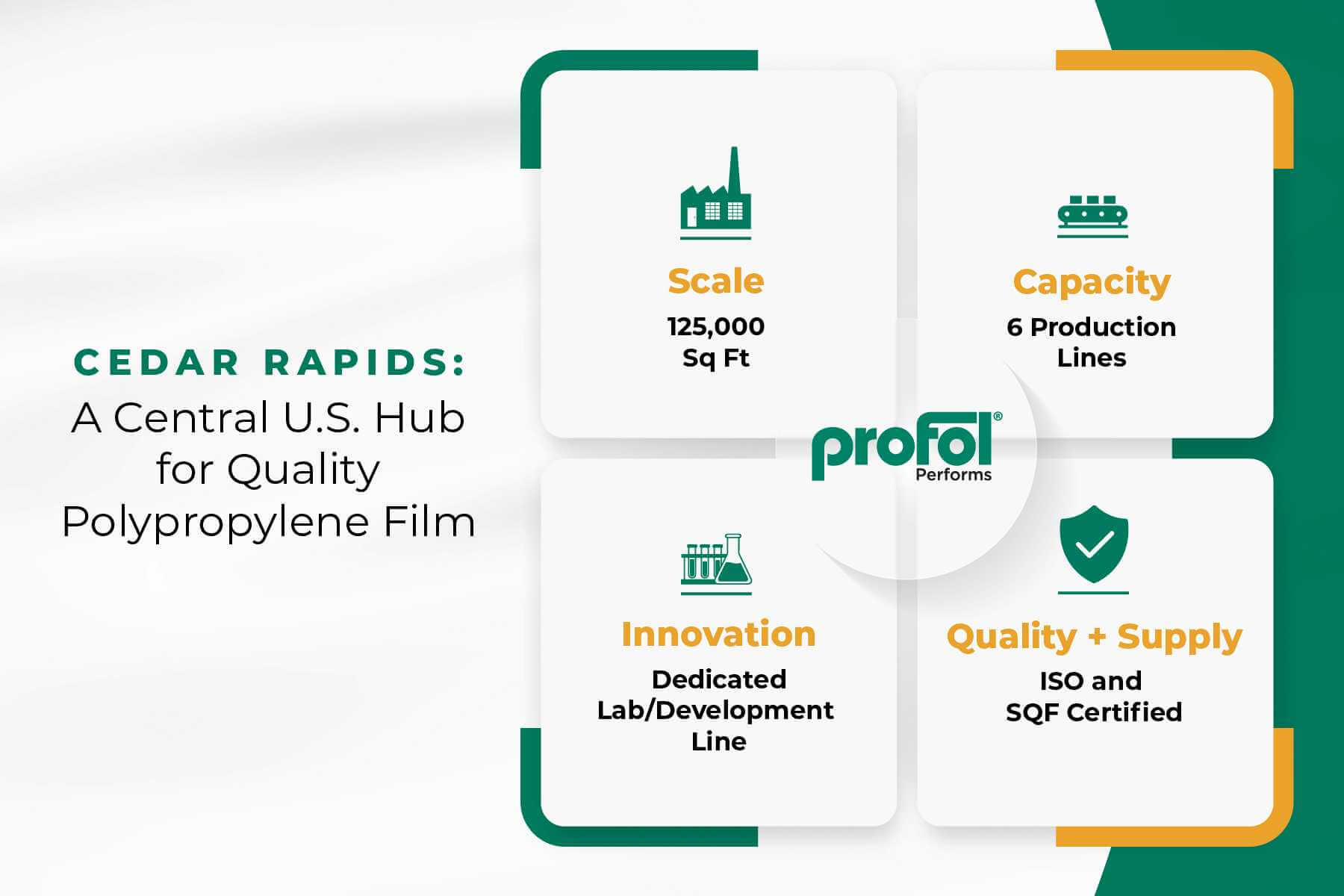
At Profol Americas, polypropylene films are produced in Cedar Rapids, Iowa, at a facility designed to support multiple industries.
The site includes:
- 125,000 square feet of manufacturing space
- Six full production lines
- A dedicated lab and development line for product innovation
- ISO 9001:2015 certified quality systems
- SQF-certified facility supporting food-related packaging applications
Located in the center of the United States, the Cedar Rapids facility allows efficient shipping to customers across North America. The location helps reduce transit times and improves supply reliability compared to overseas sourcing.
We Support Multiple Domestic Industries
From this facility, Profol produces polypropylene films for a wide range of applications, including:
- Flexible packaging films
- Building and construction materials
- Graphic printing films
- Furniture and decorative surfaces
- Stationery and specialty products
Polypropylene offers a strong balance of durability, clarity, and processing performance. It also supports mono‑material packaging structures that align with evolving sustainability goals.
Many manufacturers are now evaluating polypropylene as an alternative to mixed‑material laminates or PVC‑based solutions.
Stability in an Uncertain Market
Cost will always matter in materials sourcing. But today, reliability often matters just as much.
For U.S. companies, this is the moment to take a closer look at sourcing strategy. As trade conditions shift, businesses that rely on polypropylene film should assess their exposure to import costs, shipping delays, and supply instability—and consider whether a domestic source could offer greater predictability.
Official Trade & Legal Sources
HTS Classification and Section 301 (Baseline Data)
- USITC HTS Search (3902.10.00): https://hts.usitc.gov/search?query=3902.10
- USITC Section 301 China Tariff Reference: https://hts.usitc.gov/reststop/file?release=currentRelease&filename=China%20Tariffs
2025 Executive Actions (Liberation Day & Peak Surcharges)
- AP News (Reciprocal Tariff Announcement): https://apnews.com/article/trump-tariffs-liberation-day-2a031b3c16120a5672a6ddd01da09933
- White House (Executive Order 14257 – Reciprocal Tariffs): https://www.whitehouse.gov/presidential-actions/2025/09/modifying-the-scope-of-reciprocal-tariffs-and-establishing-procedures-for-implementing-trade-and-security-agreements/
- UPS Trade Update (Executive Order 14256 – Fentanyl Surcharges): https://assets.ups.com/adobe/assets/urn:aaid:aem:54df7a7f-a788-4445-bd9e-deb16a26ba19/original/as/tariff-developments-us-en.pdf
2026 Supreme Court Reversal (Learning Resources v. Trump)
- Thomson Reuters (Legal & Financial Impact): https://tax.thomsonreuters.com/blog/supreme-court-tariff-ruling-in-learning-resources-inc-v-trump-what-corporate-tax-and-trade-teams-need-to-know/
- Brookings Institution (Constitutional Analysis): https://www.brookings.edu/articles/brookings-experts-on-the-supreme-courts-tariff-decision/
 powered by